Going home

Delaware:

The kids sleep in my old bedroom.  I sleep in the guest room.  There are rooms to spare and we spread our things  across the house knowing it will take hours to find them again when it is time to leave. My parents get up in the morning and do the same things they have always done.  Dad’s arms sway up and out and down to the floor.  He stretches to get the blood flowing.  Mom lights the candle on her altar, says a quick prayer under her breath as the kettle sings its insistent song.  “I am ready! I am hot!”  She makes the first of three cups of morning coffee. Each one will be left in an unknown location in the house, two-thirds full, stolen away by the coffee elves.  The kitchen smells of incense, and cumin, and burnt toast.   The floor is cold.  My kids run around, and around, and around from the kitchen, into the hallway, into the dining room, and back into the kitchen.  Outside, I hear leaves rustling, acorns drop, birds twitter.

Delhi:

For the first week I am groggy. Day is night and I cannot keep my eyes open. I have never been good at dealing with changes in sleep.  The air is thick with the smell of dust, and sun, and people.  Vendors sell vegetables and hot chai. They sing their insistent songs, “Hot chai!  Ready! Good price!”  I roll out my mat to sleep on.  The floor is hard, but I soon become accustomed to sleeping this way with my cousins nearby.  I wander the streets during the day, to market and back.  I am absorbed into my uncle’s family.  We catch auto rickshaws to go to see a movie.  The roads are jammed with people and cars and motorbikes and animals. I can hardly hear myself think.

D.C.

The sun pours in through our windows into our living room, amplified by the yellow of our walls.  It is a cozy apartment.  Living room bleeds into dining area into kitchen.  Two tiny bedrooms tucked away at the back of the apartment hold all our things and all our dreams.  High shelves keep cherished books away from tiny hands.  On nice days, we choose which playground to go to.  Our playground? The school playground? The far away playground?  On rainy days, the children roam the hallway in our building, imagining worlds behind doors.  Outside, birds, sirens, hammers, helicopters, and neighbors all shout for attention.  “We are here! See us working!”

La India

She called me La India.  She was a tiny brown nut of an old woman with a crinkly hard shell.  She only wore house dresses. Her silver hair hugged her head with tight curls.  She called me “La India”  because she could not remember my name.  She was right to save that space in her brain.  I only stayed in her boarding house for two weeks.

She called me La India because I was from India, and that is all she knew. She did not call me La Americana. I spent the summer of 1998 in Puerto Rico.  It was a strange trip, a trip that came together quickly and haphazardly.  I had some contacts.  Names, addresses, and phone numbers.  I had some vague, amorphous goals.  I had a plane ticket.  When I arrived in Puerto Rico,  the telephone workers went on strike.  I could not call the people I was supposed to contact.  So I wrote them a letter.  I found a boarding house to stay in and I waited.

The old woman called me La India and I called her Senora.  Two other girls were living in the house for the summer and taking courses at the University of Puerto Rico, a few blocks away.  They were friendly but busy, and my Spanish was limited.  I spent the days wandering San Juan.  I took the bus to the beach. I walked around campus. I read books and took naps in the library. I went to the market and bought canned macaroni and cheese.  I waited.

She called me La India and it fit.  In Puerto Rico, I passed for Puerto Rican.  People were surprised when my Spanish came out in fits and starts.  They looked at me and saw una India – a Puerto Rican with native blood, indigenous.  In Puerto Rico, I passed.  My head hurt from trying to understand, trying to communicate, trying to find my way around.  My head hurt, but something else was at ease.  Eyes did not pick me out and wonder.  It felt like being in India.  It felt like another home.

She called me La India, and so often, that is what I am.  I am the Indian friend, the Indian on staff, the Indian at the party.  But for a few months in Puerto Rico, I wandered the streets of another place and was just me – alone, unobserved, free.


Big City Love

I need the Big City.  I need towering spires of steel and glass glimmering in the sun. I need feet, hundreds of feet, pounding miles of cement sidewalk.  I need my feet to pound that pavement, feeling the rhythm through my soles, into my soul. I need the Big City voices, young, old, Black, White, Brown, swelling around me into the day.  I need the push, the rush, the flushed sensation, the vibration of hundreds of thousands living en masse.  I need to feel the beating heart. I need to see poor next to rich next to me. I need to smell human beings living around me.

When my husband and I were looking to buy our first home, I spent a few days in my hometown of Wilmington, DE. My mother and I chatted about their decision to buy the home I grew up in.  My mother said, “I remember the trees, and the quiet and just feeling so good and peaceful. I just loved it here .”   I listened to my mother and in that moment, years of my own internal monologue suddenly shifted.  They LIKED living here in this suburbany neighborhood on the edge of a small city limit.  They CHOSE to live here. It’s what they WANTED. 

In my mind, the silence of my old neighborhood was a vast isolation.  The quiet of the trees echoed my own loneliness, my sleepiness, and my laziness.  I never felt truly awake.  I lived to escape to the hustle and bustle of school.  I became active in extra-curriculars because to be home was to sink down into the silence, the cool oblivion of home.  It was not a bad place. My parents were loving. I was safe and cared for in my home.  So safe that I could not be fully alive. I was dormant at home.

Things were different in India. I have family in New Delhi, Mumbai, Chennai, and Bangalore, all big cities.  Those trips were like a jolt from an enormous battery.  I couldn’t get enough.  I thought it had something to do with reconnecting to my roots, getting in touch with my Indian self.  Some of that was true.  Now I see that most of that feeling came from the energy I got from being in a Big City.

I got my  fix after I graduated from a small, rural, liberal arts college. With no job, I moved to Chicago, city of Big Shoulders.  Chicago was my power source.  The skyline fed my dreams.  The people moved me to play, and dance, and scream and fight.  I reached into myself and sent blazing trails of me out into the Chicago streets.  I laughed with the El train as it moved haltingly from the elevated tracks of streetscapes and sunshine down into the rumbling belly of darkness.  I peered out the window atop the John Hancock Tower and gazed at the solid grey silence of Lake Michigan kissing the controlled chaos of the city map.  I was in love with life. The Big City was my power source.

Now, I have two children.  The siren song of suburban life is everywhere.  “You will be safer.” “More space.” “Cheaper housing.” “Better schools.” “Everyone is doing it.”   I am not doing it. I now understand that my mom chose to live in a quiet neighborhood because it fed her soul. That was right for her.  She needed that space to reflect, to find solitude.  I need the Big City to pull me out of myself.  I need to hear the voice of the city calling me out onto the street.  I need to know my children will see humanity in all it’s messy glory every day. Maybe they will think I am crazy for  choosing that.  That’s OK too. When they grow up, they can find their own way, their own true home.  Until then, they will have to learn to respec the Big City. Maybe they too can feel the Big City Love.


Consciousness

I didn’t know,

and then I did.

I am not you.

We are not them.

This is not right.


We should fight.

We should shine a light.

We should make it right.


I didn’t know

And then I did.

I am not alone.

You are here with me.

We are all not free.

This is not right.


We should fight.

We should shine a light.

We should make it right.


I did not know

and then I did.

I am here to fight.

I will shine a light.

I can make it right.

We can make it right.


We will make it right.


My secret identities

When you see me on the street alone I am: woman, 30 something, brown-skinned, able-bodied, cis-gendered, middle-class.  If I am with my husband and kids you may also see: mother, heterosexual, and married. Hear me speak you may think: American. These categories have meaning as I walk through the world, it’s true. But I have some secret identities too. The ones that tell you who the “I” inside is.  Here they are in random order:

1. Singer of Songs: If there were still bards, I would be one. I spend one morning a month leading a Music Hour for one year olds. I can sing every word of every song in Mary Poppins, and will do so without provocation. I am the annoying person who sings along to every song on the radio, even the ones I don’t know.  I learned to play guitar just well enough to accompany myself when I sing. Song is in every cell of my body.  I am song and song is me.

2. Meddler Extraordinaire:  My favorite character on How I Met Your Mother is Lily because she cannot stop meddling AND she’s awesome at it.  Tell me your troubles and I will try to find a way to fix them. If I can’t fix them, I will find someone who can.  If you don’t know what you’re troubles are, I will tell you in the sweetest, kindest, most condescending way possible.  What can I say? I am just cool like that.

3. Accessory Navicular Survivor:  Why do museums make me sleepy before I’ve even gotten in the door? Why does shopping make me want to throw a tantrum? Why do I always say, “Is there a rabid dog chasing me? Then I’m not running.”   I always thought I was just too lazy to run, or too stupid for museums, or too unfashionable to care about shopping. Turns out, I have this extra bone in my foot that causes intermittent foot pain. I’ve had this recurring foot pain all my life. It sucked and still does, but at least now I know what it’s all about. True story.

My secret identities  are much better predictors of what I will do in a given situation (i.e. sing “The Rose” in the middle of the playground, ask about your relationship with your mother, sit on a bench at the Van Gogh exhibit) than any of those other things.  What are your secret identites?

Island of Misfit Toys

Image

“Why am I such a misfit? I am not just a nitwit. Just because my nose glows, why don’t I fit in?”-  from Rudolph the Rednosed Reindeer

We had my first Christmas when I was six: a tree, lights, and presents, the whole shebang. I asked for Christmas because Christmas was everywhere. At school we had a tree with pretend presents under it. We made ornaments out of paper. I colored mine and brought in a picture of me from home to put in the middle. Where would I hang my ornament if there was no tree at home?

Even our Indian friends had Christmas. For as long as I could remember we had spent Christmas day at Aunty and Uncle’s house. They were Christians, as were a majority of the Indians in our community.  As far as I knew we were the only ones who were not Christians, in the whole world even maybe. Why did we have to be so different from everyone else?  We didn’t celebrate any Hindu holidays.  Hinduism is a vast religion, practiced differently by different sects, casts, and states.  There were not enough Hindus in the community  from the same region of India, with the same holidays to gather together. Anyway, I wanted presents, and trees, and cookies, and milk. I wanted a stocking, and candy canes, and a My Little Pony doll.  I wanted Christmas!

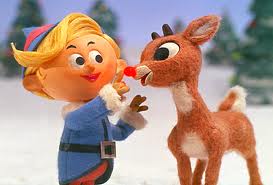
That first Christmas, my dad and I sat together on the couch in the living room watching Christmas specials on TV.  The claymation Rudolph the Reidnosed Reindeer was my favorite.  In that one, Rudolph gets teased by the other reindeer and teams up with Hermey, an elf who wants to be a dentist. They run away from Christmas Town and end up on the Island of Misfit Toys. The toys there are sad because no one wants to play with them.

I thought they were beautiful and funny: a Jack in the Box named Charlie, a water gun that shoots jelly, a toy bird that swims! The Island is ruled by a beautiful lion with wings named King Moonracer.  Rudolph and Hermey want to stay on the Island  because they are also misfits. King Moonracer tells them that they are living things and cannot hide on an island like toys. In the end, Rudolph earns his place on Santa’s team and they take the toys from the Island to children who will love them.

That first Christmas Eve, I looked out of our front window, up through the big bare tree in our front yard. Through the branches I could just make out a flashing red light in the sky. It was Rudolph coming to bring my presents. In bed that night, I heard noises on the ceiling. Rudolph! Rudolph! I thought. I shut my eyes tight to try to bring on sleep. I didn’t care about Santa so much. He never seemed very nice in that Rudolph movie.  Rudolph would know what I wanted for Christmas. Maybe he would bring me that elephant with spots. He would understand that I just wanted to fit in too.

“We may be different from the rest. Who decides the test of what we think is best?  We’re a couple of misfits. We’re a couple of misfits. What’s a matter with misfits? That’s where we fit in!”  – from Rudolph the Rednosed Reindeer

What have I learned since that first Christmas? I am still always searching for the Island of Misfit Toys.  I want to live there, even though King Moonracer says I can’t. Rudolph and Hermey were right -that’s where we fit in. My closest friends have often been misfits: the tomboy, the bi-racial girl, the not-quite-out-of-the-closet yet gay boy.  We misfits just seem to get each other, at least more than other people do.  We don’t quite belong anywhere, not even with each other,  but we can at least feel different together.

I am mad about gender

“So, what if she’s living in my house, and using my bathroom, and she’s naked in my shower, then can I rape her?”   – 13-year-old boy in a junior high violence prevention class

I am mad about gender. Biological sex is fine. Penises and vaginas exist.  People with vaginas sometimes carry babies. People with penises sometimes shoot semen into people with vaginas and make babies.   That stuff is there.  It’s true. But the rest of it, about what it all means, about who we are, and how we should behave, that’s just people collectively making shit up.

“I don’t care if someone hurts my mom. I just came out of her hole.”  – 13-year-old boy

I am sick of this gender bullshit. Gender is the original divide. The original act of othering.  We believe that we cannot understand each other and it is true because we made it that way.  Within every culture in this world,  there are two cultures embedded – man culture and woman culture, boy culture and girl culture.

“Baby, be sure to play nice with her. She’s just a girl.”  –  a mom on the playground

I have carried and birthed “girl” and I have carried and birthed “boy”.  From the moments of their births,  each one is wrapped in a different packaging.  Each one is told what s/he can and cannot do.  I do it to them as well.  I do it to them and I hate myself for it.  I hate myself because I know this is wrong.

“The real issue is the security breach.  Was the president in danger. As for the other stuff, boys will be boys.”  – military official on NPR

I have a vision.  I have a vision of genderless world. In my new world, gender expression is just personal expression.  People with penises and people with vaginas can try on all different roles, styles, emotions, and relationships.  People can be mean, and hateful, and violent towards other people just because they hate those particular people.   I am not naive.  I understand that there will not be peace on earth.  I know that there will still be murder, and abuse, and yes, even rape.  But I also know that it will not be systematic, it will not be pervasive, and it will not be targeted at someone simply because of the genitals they were born with.

“I asked him why he beat me all those years. How could he treat me like that, like a dog?  He said, it was because he didn’t see me as separate from himself.” – survivor of  20 years of domestic violence

What would it be like?  Can we imagine it?  What would the world be like today if we had thousands of years of women and men inventing things, writing books, singing songs, leading nations, making discoveries, philosophizing, or nurturing children at about the same rate?   What would it be like if today all the governments and all the corporations were run about equally by men and women? What if there were equal numbers of male and female teachers, engineers, nurses, soldiers, writers, carpenters, dancers, computer programmers, and entrepreneurs? What kind of cool shit would we have that we’ve never even thought of?

Wow.  I can’t believe I got a 3 on the AP Calculus exam. It must have been a little math angel on my shoulder. I mean, I suck at math.  – me after getting mostly “A”s in math my entire life.

I am mad about gender because I don’t even know what that would be like.  I want to be able to look back on American history and know that half the presidents were men and half were women.  I want to have learned that, of the presidents who happened to have vaginas, some were good, some were bad, some were left, some were right, some were war mongers, some were capitalists, and some were peaceniks.

I am a Hilary supporter.  Why? Because it’s time for America to have a woman president, just so that we can have more women presidents. So that 200 years from now it might be possible to say, “Hilary was the first of  a dozen women presidents. She wasn’t the best and she wasn’t the worst.”  – what I told people when they asked me why I was a Hilary supporter

I am pained about gender because it is so very limiting.  I believe that human potential is limitless.  We are each born with all of ourselves to give. But the moment we are born, we are told that we can only access half of what it means to be human.  Only half.  We are half people, all of us.

My husband and I are walking down the street pushing the kids in our double stroller. We begin to cross a street.  A stopped car pulls forward and hits the stroller. The driver was not paying attention. My husband starts shouting and tells the driver to move back. He is angry and that spurs him into action.  I check to make sure the kids are ok.  I feel nothing.  I cannot get angry like that. I wish I could.  – recent memory

I am only half a person.  If I could be angry, if I could accept that I am good at math, if I could rough-house, and play video games, and know that I am supposed to be brave, if I could walk at night without fear of rape, if I could dress  in whatever felt best to me, what more could I do with my life?  I am working to access those things.  I worry it is too late for me.  I feel pain in my heart. I want to be whole.  I don’t care anymore who “she” is. I want to know who “me” is.


Author’s Note:  All of the quotes and italics are paraphrased rememberings of what was said or thought at the time.
 

Colorblind America: Where time becomes a loop. Where time becomes a loop.

http://www.youtube.com/watch?v=QER_yqTcmjM

Worf: There is the theory of the Moebius. Where time becomes a loop.
LaForge: When we reach that point, whatever happened will happen again.

(Lines from Star Trek the Next Generation, spoken by the show’s two Black actors. )

We are stuck in a Moebius.  The eerie deja vu of Trayvon and The Help calling forth Rodney King and Hattie McDaniels.  In Ward 8 here in D.C., Marion Barry calls Asian owned businesses dirty and I feel the heat of the L.A. riots.  History is repeating itself and has been since post Civil Rights America began taking shape.

In “By the Color of Our Skin: The Illusion of Integration and the Reality of Race” by Leonard Steinhorn and Barbara Diggs-Brown, the authors analyze the post Civil Rights era to assess the effort to integrate America. The authors argue that, since the civil rights movement, Black and White integration is more common in public spaces such as workplaces, schools, and shops.  They agree that this has an overall positive impact on the status of Blacks in America.

However, in private spaces, segregation is the norm.  People tend to associate with members of their own race. In many cases this is because Whites fear Blacks and  Blacks mistrust Whites because Whites fear Blacks.  Meanwhile, in TV and movies Blacks and Whites associate with each other far more than they do in the real world, giving our couch-potato society the impression that integration has been achieved. Where time becomes a loop.  Steinhorn and Diggs-Brown go on. They argue that Whites forget that the long history of White Supremacy and the legacy of Black enslavement taint many interactions that Whites deem “harmless”.  Misunderstandings abound. Distance increases. I argue that this is true for all non-Black people. Black people are isolated by anti-Black racism in America.

Politicians from both parties, including Barack Obama, wax poetic about King’s dream of a colorblind society. They carefully ignore King’s belief that America would require a policy of reverse discrimination against White’s in order to correct for hundreds of years of slavery and oppression. Meanwhile, affirmative action opponents use King’s words to make sure this never happens. A colorblind society cannot, in the end, acknowledge the traumatic impact of slavery on Black people in America.  But the song goes on. Where time becomes a loop.

Anti-black racism in America is real, occurring now, and unique amongst oppressions experienced by people of color in America.  Tamara K. Nopper has a great piece on this in her blog :http://tamaranopper.com/2012/04/20/george-zimmerman%E2%80%99s-minority-defense-and-the-1992-los-angeles-riots/

As an Asian immigrant in America, I do not experience anti-black racism.  Nor do I know what it is like to be Black in America.  I do not share a history of slavery, and systematic degradation of my entire group. My people have not been called  animals or less than human. My people have not been marginalized from work.  My people have not been imprisoned en masse.  My people are not seen as lazy, or chronically poor.  I do not carry the weight of  these stereotypes  on my shoulders.  And when I behave in ways that counter these particular stereotypes I am not accused of acting White.

I have worked in coalition with Black women as part of women of color organizing. I have been enriched by these interactions and I hope I have been an ally to them.  But the truth is, our groups’ causes are not the same.  Unless I acknowledge this, I cannot be sure that I am being an ally to Black women.  Unless I truly get this,  the things I do in the name of racial justice for all may in fact be singing the same old colorblind song.  Where time becomes a loop.

How can America break free from this colorblind loop? How can America break free from this colorblind loop? How can America break free from this colorblind  loop. How can America break free from this colorblind loop?

By seeing the colors and knowing their stories. Steinhorn and Diggs-Brown offer a few ideas on how to do this as it applies to anti-Black racism in America:

1. Stop trying to achieve the integration gold star. Whites and Blacks don’t have to do everything together in order to peacefully coexist. In India we have 20 something states, each with its own language, culture, film industry, and food.   People still relate to each other enough that they can have a national government that functions.

2.  Do something to atone for slavery.  The playing field is in no way level after 400 years of systematic subjugation.  Acknowledge it. Make it a national priority.  Tell people who don’t like it to suck it up and move somewhere else.

3.  Put real race talk on TV everywhere. In shows. In public service announcements. We need some MadMen style campaigns to counter anti-Black bias in America.  End tokenism and increase the number of shows that reflect the real internal lives of different groups of people.

4.  This one is based on my own thinking and  is backed up by Tamara Nopper’s piece.  Stop lumping people of color together. And that means non-Black people of color need to get on board with acknowledging anti-Black racism as singular. We need to recognize that justice for Black people is at the core of achieveing justice for all people in America.  When Black  people talk about how something is racist like “The Help” (see another Tamara Nopper piece http://tamaranopper.com/2012/02/28/be-the-help-campaign-black-disappearance-among-the-multiracial-left/)  we need to listen and  ground our own actions on analyses generated by Black folks.

That doesn’t mean the struggles of non-Black people of color are not important. Native people in America also experienced a singular oppression based on colonization and genocide.  The experience of immigrant people of color is another experience entirely. Chicanos who were crossed by the border fight another battle altogether. Muslims in America today are demonized in ways I can only sense from being mistaken for Muslim. We must see these differences clearly in order to strategize and support each other.   We don’t have to stay on the merry go around trying to make our horse go up while others go down.   If we do, “when we reach that point, whatever happened will happen again.” Where time becomes a loop. Where time becomes a loop.

Steinhorn, L. & Diggs-Brown, B. (2000). By the color of our skin: The illusion of integration and the reality of race. Plume. NY.

  Primary Impressions: Age 6-8 or so (Vol 4)

My bharatnatyam teacher’s name is Anuja Aunty.  Anuja Aunty is funny and pretty and she wears glasses. We have class in someone’s basement. It’s a nice basement with carpet and sofas. There is a  practice room with hard wood floors and mirrors too which is perfect for dancing.  I run into the practice room and pull out my ankle bells. They are heavy to lift and make ching-ching sounds when I move them.  I strap them to my ankles and buckle them by myself.  Anuja aunty presses play on the tape player.  “Everyone up!  Let’s start from the beginning. ”  The music plays “Sa. Reesa tha pa magga sari ma. Sari magga mapa reesa!” I sing along. My feet stomp. Ching-ching.  “Theya-theya dhi- dhit theya.” My hands flow around me. Closed flower. Open flower. My eyes look forward. “Good, Aarati, good!” Anuja Aunty’s hair swings back and forth in a long thick braid. My heart pounds. My feet stomp. My hands move. Ching-ching. I am me.

I don’t like Indian Sunday School.  I don’t know any of the kids and the teachers are mean.  Some of my school friends go to Sunday school so I thought it would be fun, but it’s not.  We have to drive a  long way to get here.  The teacher is an Indian man with glasses and he talks with a thick accent. He stands in front of the chalkboard.   He has a long stick that he uses to point at the letters on the board.  “Ah-aah. E-eeee. U-uuuu. Aha.”  The letters are squiggly and hard to write. I am sleepy. I am bored. I fold my arms on my desk and lay my head down. I want to go home.  “Aarati! Pay attention please,” he says.  I sit up, and think about what kind of ice cream I will ask for on the way home.

We are having a pageant today. Parents are coming. I am wearing my Indian dance clothes and waiting on stage for someone to come help me.  This aunty has made  a picture of ten arms on a big cardboard cut-out.  The arms are all holding different things.  She is taping it to my back. In my real hands I have a cardboard sword in one and a cardboard axe in the other. I climb up on a small stool.  In front of the stool there is a big lion picture made out of cardboard too.  The other kids get into position but I can’t see them because we are all in a row.  I hold my real arms up and out under the cardboard arms. The aunty says, “Aarati, you look beautiful. Your long hair is perfect for this.”  The curtain opens.  Lots of moms and dads are sitting in the seats.  I can’t see mine.  My teacher walks over to me with his microphone. “This is goddess Durga. She is a fierce warrior who has vanquished many demons. She is brave and strong. She rides a lion”  My face feels hot because I am so happy.